Ww Ii Us Army Air Force B24 Bomber Clip Art
/https://tf-cmsv2-smithsonianmag-media.s3.amazonaws.com/filer/JJ11-Two-Days-in-The-Life-of-a-B24-crew-1-FLASH.jpg)
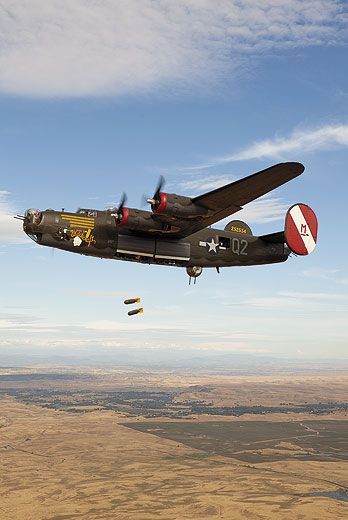
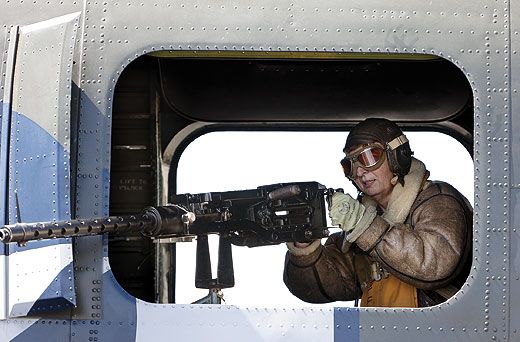
Endeavour not to show it's your get-go mission on a B-24. As the shipping banks into a bomb run, .50-caliber waist guns jackhammer the air with bursts of defensive burn down. The bomb bay doors growl open up, and the fuselage is filled with hot wind and frazzle fumes. On one of the bombs, someone has scrawled a greeting to "Adolph." A huge cantankerous mark has been mowed into a hay field below and covered with hundreds of pounds of puff-producing white flour.
Welcome to Globe State of war II Bomber Crew Fantasy Camp. Don't get stuck in the ball turret. Or call sergeants "sir."
The camp is sponsored by the Collings Foundation, a group known for preserving and flying vintage aircraft, and the 2010 session drew 12 "cadets" willing to pay well-nigh $4,000 each to experience ii days as B-24 airmen. On its Wings of Freedom tours, Collings offers glimpses of air combat with wing-alongs in its renowned warbird collection. Fantasy Camp, even so, turns toe-dipping into total immersion.
"It's a vision I'd had since grade schoolhouse," says Taigh Ramey, president of the nonprofit Stockton Field Aviation Museum in California. Ramey, who owns Vintage Aircraft, a company specializing in the restoration of warbirds and antique aircraft, provided radios for Collings' fleet, then expanded into piloting the classic airplanes. Four years ago, he presented his thought to foundation executive director Rob Collings: "I said, 'Hey Rob, could we, uh, drop bombs out of your planes and shoot the guns?' Rob thought for a minute and said, 'I don't run across why not.' "
There were a number of reasons why not. "You're taking an historic aeroplane, restored to look authentic, and making it into an aircraft capable of doing everything information technology did in Earth State of war Ii—not merely looking like it could," says Collings. The period-faithful had to be made 21st century functional. Ramey and nigh 10 volunteers from the Stockton Field museum had to reactivate inoperative flop racks and rewire gun turrets. To back up .50-caliber machine guns that really fired (rented from suppliers to Hollywood studios), they reinforced gun mounts.
Locating a target range advisable for the cement bombs was also an outcome. Luckily, Stockton Field museum vice president Ken Terpstra has friends with large, private ranches. One friend fabricated his ranch available for the bombing runs; another for a gunnery range.
Paying participants started booking in 2009, and, despite the moribund economy, final twelvemonth's campsite had i more camper than the 2009 session.
DAY Ane, 7 A.K. In the lobby of a Vacation Inn, a pair of uniformed U.S. Army Air Forces not-coms—1940s-correct down to glasses and wristwatches—bawl out a roster of names. Guests at the continental breakfast bar gape as the olive-drab cadre boards a bus bound for the preparation schoolhouse at Stockton Army Air Field (meliorate known as Stockton Metropolitan Airport).
Brothers Chris and Craig Connor from Long Island, New York, are on the bus. Craig is a U.S. Air National Baby-sit flight engineer on Lockheed C-130s. Both brothers are hardcore World War Two buffs and collectors. "To feel fifty-fifty a minuscule cantankerous-department of what bomber crews endured during the war is going to be incredible," Craig tells me. "That's why we're here."
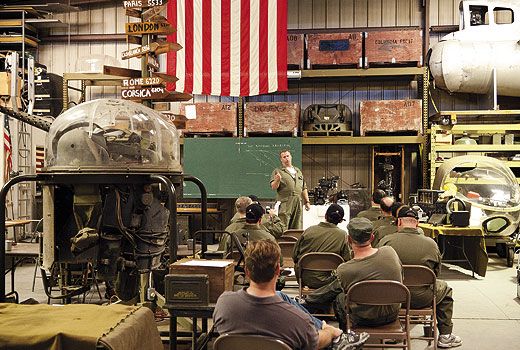
In the shadow of the Stockton command tower, Ramey and the volunteers have transformed the Stockton Field museum's 1970s prefab hangar into a Earth War Two barracks. Bunks and footlockers line one wall. Belts of .50-caliber ammo overflow stenciled wood crates. A lounging re-enactor reads circa-1940s magazines. On the walls are posted orders in the jittery font of transmission typewriters, and the mock mail from dwelling bears three-cent victory stamps.
Out in the parking lot, the vibe is decidedly pre-New Army. "Go this through your thick skulls," roars a sweating sergeant named Murphy at campers continuing at attention (sort of). "See these stripes? I actually work for a living. I am not a 'sir.' "
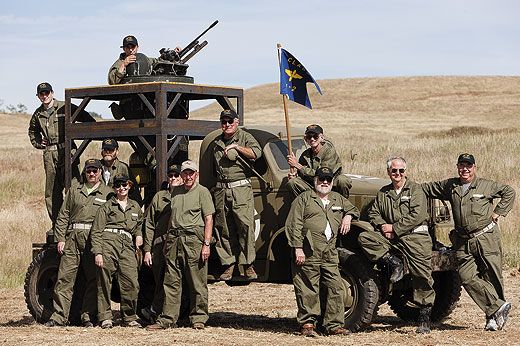
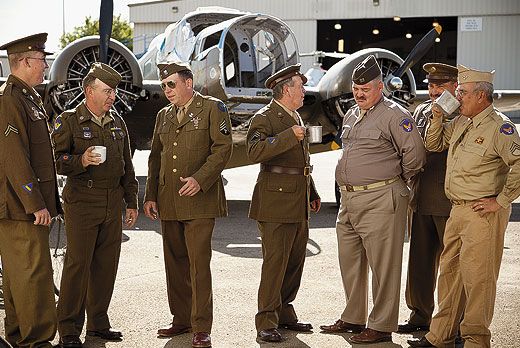
A 60-year old ex-Marine, Tim Murphy is one of almost 10 volunteer re-enactors populating the illusion. Most are members of the Arizona Ground Crew Living History Unit, based in Phoenix. Genial and low-primal behind the scenes, Murphy describes their mission simply: "Folks come here wanting to exist immersed in World State of war II. Well, we're gonna drown you lot." He plays the part like a B-flick character player, bellowing and blustering, venting harangue and sly sense of humor. All function of the make-believe, sure. But when Sergeant Spud gets in your face up, y'all wipe off that grin and shape upward.
Jamie Stowell is the sole female camper. A power filigree controller from Sacramento, she's already drawn the nickname "Miss Roosevelt" from White potato. ("Yous gotta be related to the president, 'cause I don't know how y'all got into the Army Air Corps otherwise.") Actually, Stowell'south father trained in B-24s before requesting a transfer to the North American B-25. During combat in Europe, he was a B-25 shipping commander. Stowell is here as a tribute to his service. "I think it'due south going to be really absurd to go far the turrets and meet what my begetter went through," she says.
In the role of ranking officer, Helm Bill Gaston, some other Arizona re-enactor, wears a apartment-brimmed campaign lid and khakis with razor creases. He remains meticulously in character at all times, ordering united states about in clipped, unsmiling sentences. Afterward a faded Army filmstrip on venereal disease prevention—"Mandatory!" he snaps—a one-half-day cram course begins.
Navigation, armament, and flop delivery, along with real-life hardware, are fast-tracked through show and tell. Instructor credentials are impressive: Jim Goolsby, one of the pilots of the Collings B-24, teaches navigation and radios. A retired United Airlines 747 captain, Goolsby began as a commercial airline navigator on Boeing 707s.
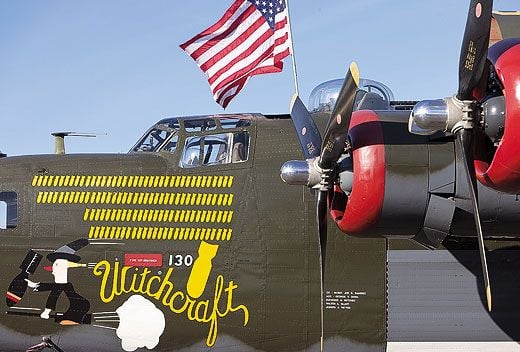
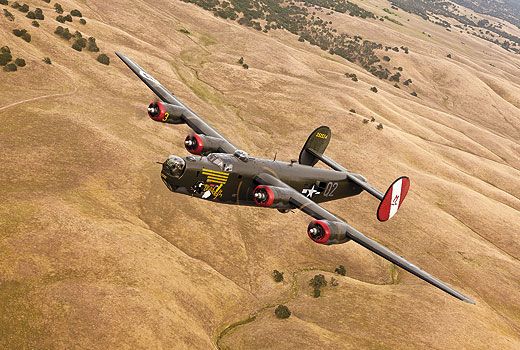
Parked a hundred yards from fantasy camp is a Consolidated B-24J Liberator named Witchcraft, in honor of a European-theater bomber that flew 130 missions with the Eighth Air Forcefulness. Congenital in 1944, our bomber flew with the Royal Air Force under the Lend-Lease Act. After, in the Pacific, it pulled anti-sub patrol on missions lasting more than twenty hours. Then and now, Boeing'southward B-17 got the glamour. But the four-engine B-24 was the Big War workhorse, shouldering more than tonnage than any other bomber in the U.S. fleet.
MO LEVICH is a jazz trumpeter and director of a Bay Area big ring that has performed for years beneath the wings of Collings Foundation bombers at airshows. That'southward no coincidence: Levich's home library is devoted entirely to World State of war Ii history. "I've studied this stuff since I was five or six years old," he tells me during a break from form instruction. But his hitch at B-24 camp results from deeper gravitational forces. "I was pulled here because of my background," he says. A few members of Levich'southward family, Polish Jews, got out of Europe after Federal republic of germany was defeated. "All I can do at present is come here and honour the guys who flew these airplanes," he says. "Considering if they hadn't prevailed and so, I wouldn't exist here today."
Levich and the other cadets gather in the hangar-turned-classroom. "Turn off the cameras," says Taigh Ramey, "and close the doors." The Norden bombsight is unveiled. Though its mythology overshadows its real-world accuracy, the Norden was one of the war's most guarded secrets. Information technology's a mechanical brain with hundreds of moving parts, capable of steering the course to the target and computing the bomb release betoken. A bombsight historian and collector, Ramey fills the chalkboard with diagrams depicting drift angle, track, and air current speed. In example nosotros're forced downwards, he passes around in one case-classified documentation showing precisely where to shoot a Norden with a .45 pistol to get in unusable to the enemy.
1 p.m. Luncheon under a camp canopy on a sun-bleached ranch. The baloney sandwich buffet is from a Earth War Ii Army recipe book, and the food is served in mess tins.
Afterward luncheon, nosotros make our manner to a makeshift gunnery range to perforate newspaper airplanes with everything from machine guns to handguns. A 1942 Chevy turret trainer truck rests in a patch of shade. Using a shotgun mounted inside the powered turret, campers learn aeriform targeting. Clay pigeons simulate attacking fighters.
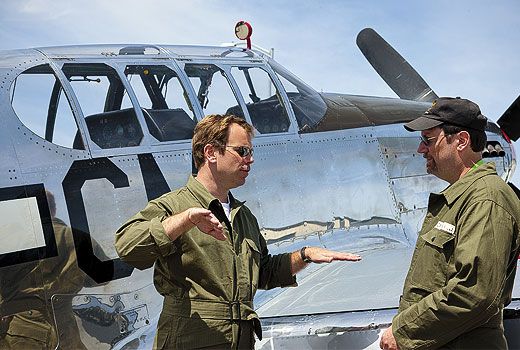
Rob Collings arrived in Stockton piloting the P-51 Mustang Betty Jane. As a multi-caliber salvo erupts, he describes how the Collings Foundation'due south philosophy shaped the camp. "Our whole mission is living history," he says. "The airplane rides take been ane office of it. Now we want to get more of that feel across. We can't show campers all the hardships of war, certainly, but we tin can show them the training and what people had to become through on a daily ground."
The logistics are daunting. "Specially when you want to shoot machine guns," says Collings. "There are lots of places where you just can't do that."
"I'm non a gun nut," Jamie Stowell assures me after her turn at the thundering .fifty-caliber. "Just oh my God! It's just astonishing power." Cipher like the rat-tat rattle of pic motorcar guns, the fire-spitting Browning quakes the air and even the ground beneath your anxiety.
Over at the preparation turret, clay pigeons maintain air superiority. Few 21st century skills are transferable to sitting in a rotating turret while simultaneously adjusting gun elevation and manually tracking an unfriendly in three dimensions. Craig Connor respects the lower-tech ethos of 1944. After climbing down from the turret, he says: "In Globe War II, the human aspect of a bomber crew, the interaction between those guys, was everything. Now black boxes tell you where to go and what to do. Technology but takes people further and farther out of the picture show."
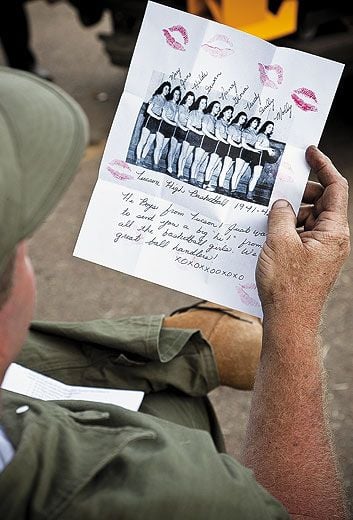
Recoil bruises, intense sunlight, and the umpteenth .l-caliber cartridge jam somewhen sap campers' trigger-happiness. Back in Stockton, the 12-hour day ends with re-enactors reading aloud imitation letters from home. "You may render to your barracks," Captain Gaston commands, "and autumn unconscious."
24-hour interval Two, 7 A.M. Above Witchcraft, an American flag flutters in clear morning calorie-free. As Jim Goolsby conducts a walk-through of the B-24, he exudes more than tough dear than romanticism. Mo Levich inquires near the big bomber's glide ratio; "A little amend than a brick," he replies bluntly.
Up narrow steps, the flight deck is a museum of state of war production ergonomics: banks of dials and toggles flanked past handles and levers. Command of the bomber's large flying surfaces is unassisted past hydraulics. "They're a fiddling heavier than what you're used to in a Cessna," Goolsby tells Levich as nosotros test the activeness. Rudders accept the pedal travel of an elliptical trainer at the gym. Pulling the control cycle back to its limit, you experience every foot of greased cable winding through pulleys and stretching dorsum to the big elevators.
How practice today'due south pilots relate to Witchcraft's wing-by-might controls and primitive cockpit surroundings? "We get jet jockeys in here all the time," says Goolsby, "and they do a terrible job. We've too had people who fly for the airlines railroad train to fly it and they'll tell you lot, this ain't anything like an airliner."
Re-enactor Sergeant Ken Terpstra, of the Stockton Field museum, has Globe War II bomber nose art tattooed on his right arm, so I'yard not surprised when he says, "I should take been born a long time ago." A San Joaquin Canton deputy sheriff, he stands atop the ball turret trainer, psyching up volunteers to squeeze into the metal orb with the plexiglass porthole. Not everyone wants to—or can. After grooming in basic rotation and target tracking, Terpstra instructs aspirants to betoken him in instance of sudden claustrophobia and/or vertigo. "I'll get you out of there quick," he promises.
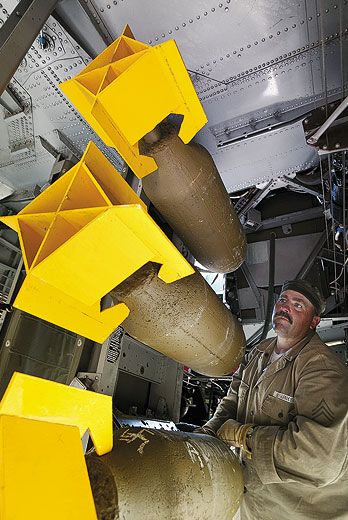
Mid-morning lethargy is staved off by loading 220-pound cement bombs into Witchcraft's bay. Oil must exist purged from engine cylinders as well. "I'll do the freakin' counting for you," Sergeant Murphy shouts as we manually push the enormous props through a prescribed number of revolutions.
1 p.m. Captain Gaston delivers the conference. There will be ii 80-infinitesimal flights, each conveying a six-camper coiffure. Our target is in a hay field on a private ranch east of Stockton.
Board the B-24 through the bomb bay (unless yous're i of the uninitiated). Within, Ken Terpstra encourages us to "become the whole experience." He grants us free rein, just warning us that after the bomb doors open at altitude, we shouldn't stroll along the 12-inch-wide flop bay catwalk. (Strike that off the bucket list.)
Iv aircraft with a combined age of more 250 years brand a time-tripping lineup on the Stockton taxiway. Vintage Aircraft'south Twin Beech is a camera shipping (an opportunity to shoot a B-24 dropping bombs and firing auto guns attracts major photog talent), and a Stinson Fifty-5 volition scout the target. Nosotros tin can await opposition, but not—as we'd hoped—the Collings' Messerschmitt Me 262 (it's grounded). Instead, Rob Collings will airplane pilot the P-51.
Witchcraft's takeoff roll seems interminable. But the climbout with all 56 cylinders hammering—that big wing banking in the sun—is glorious. Long before cruising altitude, seat belts click off. One camper is already walking toward the rear gun position. I'm crawling through a duct-like tunnel beneath the cockpit into the olfactory organ.
What aeroplane buff hasn't imagined how it must accept been in the war, perched up front in a glass bubble, plowing through bluish sky with the might of a bomber roaring at your back? This flight is just like it was, without the deadly flak. Below, in the bombardier'south compartment, Taigh Ramey lets me peer into the Norden bombsight. The crosshairs drift across a turquoise swimming pool, then a small-town mini-mall. I imagine people looking upwards.
Over the ranch, reports from a .50-quotient percuss the fuselage. Mo Levich is alternating single shots with staccato bursts—okay, they're blanks—out the waist-gun port, leaning into the recoil as he tracks a target at 10 o'clock low. Due to mechanical problems, the P-51 has returned to base, so we're targeting the camera shipping instead. No aggro Mustang, the docile Beech is easier to rail than a dirt pigeon.
Chris Connor is manning the brawl turret, pulling 360-degree rotations and inclining the guns vertically. Fantasize this: Yous're crammed inside a Christmas ornament suspended from the bomber's belly while arcing Bf 109s fire 20-mm cannon at you.
Nosotros've banked repeatedly, dropping altitude in increments. At present we level into an arrow-straight path, with but slight deviations. Up in the bombardier's compartment, Ramey feeds corrections to the cockpit equally the Norden figures the path and calculates the release point. The bomb bay bong jangles, and doors retract. Most a quarter-ton of cement heads for the target.
Subsequently two more bombing runs (no plume of flour noted), we head for base. After nosotros land, mission two, hauling six more campers, departs. A second P-51 is scrambled to serve as a target stand up-in.
When everyone's back on the basis, in that location'south a graduation anniversary outside the Stockton Field museum's hangar. Ribbons are awarded at attention and the class guidon retired. Sergeant Murphy, in full dress uniform, barks his final club: "Dismissed for grub and inebriation."
Later, the campers relish cold beers and grilled steaks. Tim Murphy is wearing a flowered shirt. Bill Gaston is smiling. Jamie Stowell now knows something of her father's experience "and the astonishing level of courage it took to practice it."
Craig Connor leaves with a connection to his own service in C-130s: "Could nosotros follow in those guys' footsteps? I don't think and so. But the crew esprit and the mission—all of that still exists today. I'll be dorsum on duty Tuesday."
Mo Levich's years of inquiry have a first-paw dimension at present. "For me, in that location's no more imagining what those men did for us and what we owe them. We owe them...." His voice trails off and he shakes his head. "I tin't fill up in the residue."
Equally the class of 2010 checks out of Fantasy Camp, reality looms in the silent silhouette of a B-24 in the solar day'due south fading twilight, and the spirit of those who flew it 65 years ago.
Stephen Joiner is a frequent Air & Infinite/Smithsonian correspondent.
Source: https://www.smithsonianmag.com/air-space-magazine/two-days-in-the-life-of-a-b-24-crew-161318974/
0 Response to "Ww Ii Us Army Air Force B24 Bomber Clip Art"
Post a Comment