Does the Delaware Art Museum Have Any Mary Page Evans Paintings
The all-time paintings at the Museum of Mod Art (MoMA)
Cheque out our guide to the best pieces on view right now at the earth-renowned Museum of Mod Fine art in NYC
Amid NYC's art museums, MoMA's drove of 20th-century artworks is arguably unrivaled among other holdings, like those of The Metropolitan Museum Of Art or the Solomon R. Guggenheim Museum. MoMA, later all, has "Modernistic Art" right in its name, and beginning in 1929, it pioneered the acquisitions of masterpieces in Postimpressionism, Cubism, Surrealism and abstraction—not to mention Pop Fine art and works past leading contemporary artists. Though MoMA possesses works in all mediums, its horde of paintings takes centre phase in its collection, equally you can see in our list of the best paintings at the Museum of Modern Fine art (MoMA).
RECOMMENDED: A full guide to the Museum of Modern Fine art
Best paintings at the Museum of Modern Fine art
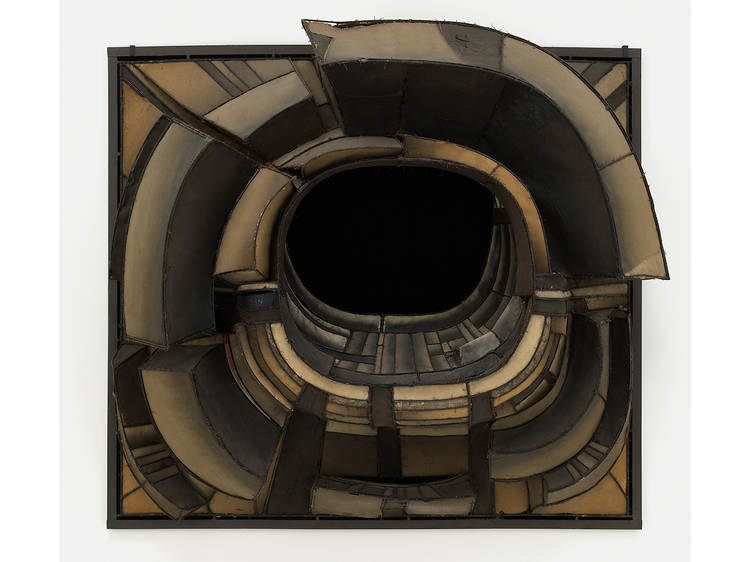
1. Lee Bontecou, Untitled (1961)
In the macho scene of postwar American art, Bontecou was a rare female presence, just when it came to making tough work, she could keep up with the boys and so some. This piece is fabricated with industrial sail salvaged from a conveyor chugalug that had been tossed out on the street by a laundry located below the artist's East Village apartment. The glowering form—suggesting a wormhole into some dimension of Cold State of war terror, or an eyepiece from a gas mask—was achieved past stretching fabric across a steel frame.

2. Salvador Dalì, The Persistence of Memory (1931)
Dalì described his meticulously rendered works every bit "hand-painted dream photographs," and certainly, the melted watches that make their advent in this Surrealist masterpiece have get familiar symbols of that moment when reverie seems to uncannily invade the everyday. The coast of the creative person's native Catalonia serves as the backdrop for this landscape of time, in which infinity and decay are held in equipoise. Equally for the odd rubbery creature in the center of the composition, it is the artist himself, or rather his profile, stretched and flattened like Silly Putty.

3. Willem de Kooning, Woman I (1950–52)
In the signature painting of De Kooning'due south career, the artist jokingly inserts an interplay between enormous eyes and breasts (strapped downward here as if they might burst from the flick plane and smother the viewer), taunting us with the question, which would you look at first? The flurry of violent marks defining the figure could exist hands read as misogynistic, just lament about misogyny in New York's postwar art globe is a bit similar complaining that Rembrandt didn't take electric lights. With her verticality and frontal positioning, /Woman I/ seems enthroned: the regent of De Kooning'southward imagination.

4. Frida Kahlo, Self-Portrait with Cropped Hair (1940)
This gender-bending self-portrait by the celebrated Mexican artist and feminist icon was occasioned by her divorce from Diego Rivera—the muralist notable not only for his own artistic genius, but for his philandering ways. Kahlo had plainly plenty of the latter, merely equally the painting indicates, she couldn't quite quit Rivera. She pictures herself in a chair, pilus shorn, with her signature peasant blouse and skirt replaced by Rivera'due south dress—effectively transforming herself into her ex-husband's likeness. Her locks, now scattered beyond the floor, seem to writhe menacingly effectually her, and she captioned the limerick with the words from a popular Mexican love song: "Await, if I loved you information technology was because of your hair. Now that you are without pilus, I don't dearest yous anymore." Unsurprisingly, Kahlo remarried Rivera the following year, so this weirdly compelling painting could also exist described as a monument to codependency.

v. Roy Lichtenstein, Drowning Daughter (1963)
Lichtenstein's Pop icon is at once a coolly ironic deconstruction of lurid melodrama and a formally dynamic—even moving—limerick, thanks largely to the interplay of the subject's hair (swept into a perfect Mad Men–era coif) and the waves (which seem to have wandered in from a Hokusai print) threatening her. The image, a crop from a panel in an early on-'60s comic book titled Run for Love!, shows that Lichtenstein'southward in total command of his mode, employing not but by his well-known Ben-Day dots, but also assuming black lines corralling areas of deep blue. It's a complete stunner.
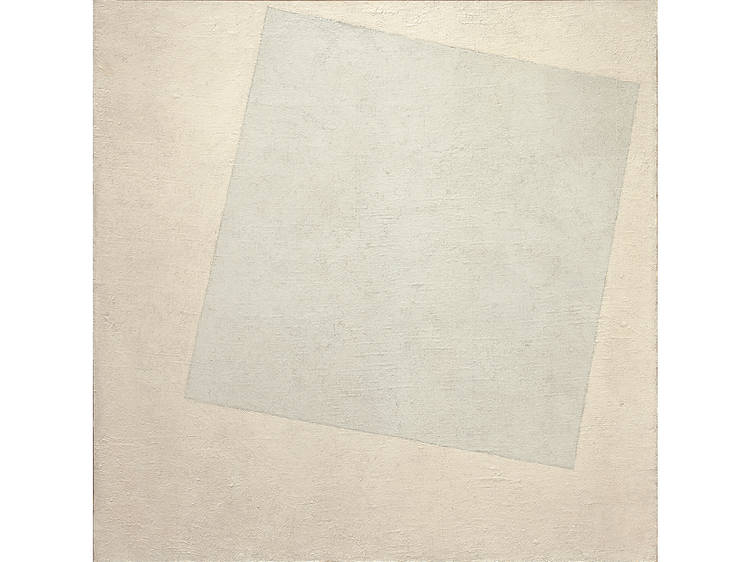
6. Kazimir Malevich, White on White (1918)
Though it was painted most a century ago, this painting's radical nature continues to amaze. Malevich'south aim wasn't pure reductivism, though. Inspired by Russia's icon tradition, the early Soviet avant-gardist believed that the Russian Revolution had ushered in a new age in which materialism would give way to spirituality. He chosen his philosophy Suprematism, and /White on White/ serves as the supreme manifestation of the artist reaching for transcendence.
seven. Henri Matisse, The Piano Lesson (1916)
One of the artist's most personal pieces, The Piano Lesson shows Matisse's son Pierre at the keyboard. It's a composition about space, just also nigh time, as it echoes over again and once again the pyramidal shape of the metronome on the pianoforte—in the band of green slicing beyond a casement to the left, and in the shadow falling across Pierre's face up. He is fix between two of his father's works depicting females, the matronly Woman on a High Stool and a small sculpture of a sensuous, reclining nude. More a simple description of a family unit life, The Piano Lesson serves as a meditation on manhood, and one boy's impending introduction to it.

8. Pablo Picasso, Les Demoiselles d'Avignon (1907)
The ur-canvas of 20th-century art, Les Demoiselles d'Avignon ushered in the modernistic era by decisively breaking with the representational tradition of Western painting, incorporating allusions to the African masks that Picasso had seen in Paris'due south ethnographic museum at the Palais du Trocadro. It'south compositional Deoxyribonucleic acid also includes El Greco's The Vision of Saint John (1608–xiv), now hanging in the Metropolitan Museum of Art. The women being intruded upon past the minor still-life at the lesser of frame are really prostitutes in a brothel. An early study for the painting featured a medical educatee entering from the left to make his selection for the night, but Picasso wisely decided to leave him out in the last composition, leaving simply Avignon in the title as a clue to his subject field's origin: It'south the proper name of a street in the creative person'due south native Barcelona, famous for its cathouses.
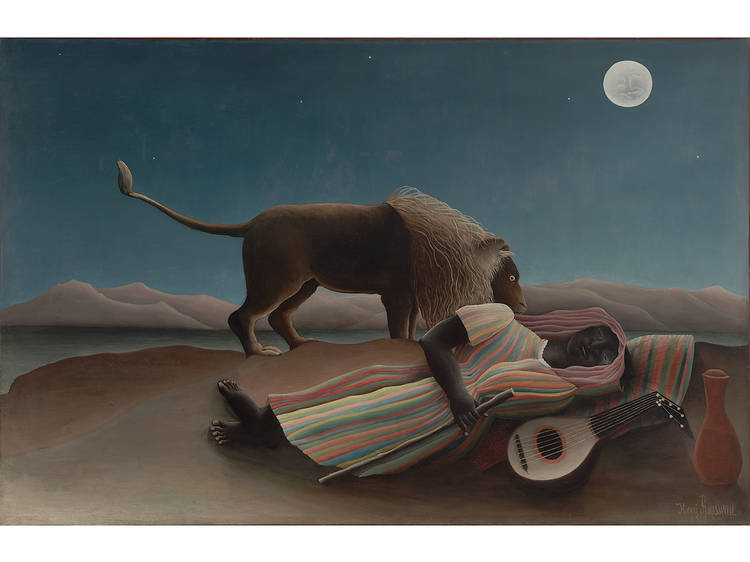
9. Henri Rousseau, The Sleeping Gypsy (1897)
Rousseau's career represents the kickoff instance, perhaps, of a cocky-taught outsider artist who won the admiration of insider peers, though the road to recognition wasn't easy. The story goes that Picasso offset stumbled upon the work of this cost-collector-turned-painter while it was existence sold on the sidewalk every bit used sheet to be painted over. Since then, Rousseau's mix of dreamy naive figuration and exotic landscapes (all imagined; he never left France) has become indelible—never more and then than in this painting, in which the juxtaposition of beauty and beast has an unearthly quality.

10. Vincent van Gogh, The Starry Night, 1889
Probably Van Gogh's most famous and popular painting, The Starry Night has inspired, amid other things, a treacly 1971 ballad by the musician Don McClean. For virtually people, the swirling, cyclonic tone of the painting is a direct reflection of Van Gogh's reputation every bit a turbulent soul. Indeed, he painted the scene while he was a patient at the Saint-Paul mental asylum in Saint-Rémy, where he sought handling for low and hallucinations.

11. James Ensor, Masks Confronting Death, 1888
Known for paintings featuring masks and skulls, the Belgian creative person James Ensor is ofttimes seen as a precursor of Surrealism, which is true upwardly to a betoken. Though seemingly Surreal in the broad sense of the term, his work wasn't concerned with dreams or the unconscious (which would later become Surrealist obsessions), but rather with the futility and irony of being. Furthermore, his themes were rooted in directly observation, equally the ghouls and goblins that populate his imagery didn't spring from his imagination, but were based instead on props and costumes set up in his studio (a legacy of the family business, a small emporium that sold festive get-ups and souvenirs to tourists who came to Ensor's seaside hometown of Ostend for its annual Mardi Gras–fashion funfair). Such a tableau is featured in this painting where the key figure, representing death, is actually a skull plopped on an arrangement of empty clothes. The same goes for the masked subjects crowding effectually grim reaper, who wears an elaborate lady's hat, giving the scene an unnerving erotic undertone.

12. Andy Warhol, Gold Marilyn Monroe (1962)
No Warhol demonstrates the creative person'southward worship of glamour better than this painting, created the year Monroe died in an apparent suicide. It is the altarpiece in Andy's Pop Art church building of glory. Simply by the same token, the work besides speaks to Warhol's background every bit an observant Catholic; it wouldn't look all that out of place at St. Peter's Basilica in Rome or at St. Patrick's Cathedral on Fifth Avenue, where Warhol regularly attended mass (sans wig). The paradigm is based on a publicity still for the motion-picture show Niagara, in which Monroe played contrary Joseph Cotton every bit an unhappily married woman, plotting the murder of her husband.

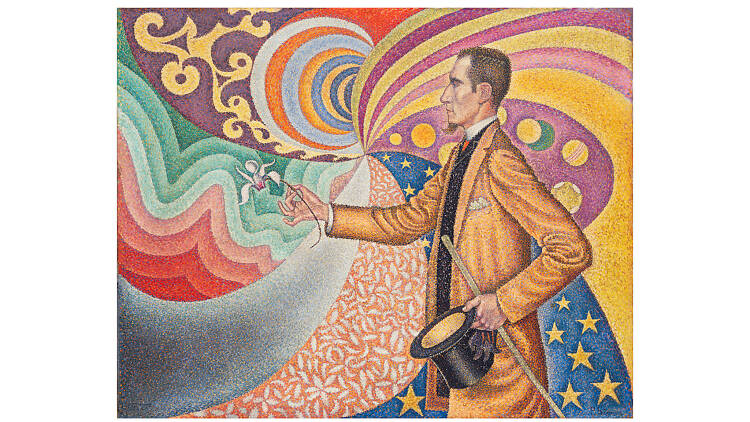
thirteen. Paul Signac, Opus 217. Against the Enamel of a Background Rhythmic with Beats and Angles, Tones, and Tints, Portrait of M. Félix Fénéon in 1890, 1890
Near the end of the xixth century, Impressionism's spontaneous mode of painting gave style to Postimpressionism and its more methodical forms of expression. It was in this context that Pointillism emerged, and while usually associated with Georges Seurat, Paul Signac was another major effigy of the motility. His all-time-known piece of work is this exuberant—almost psychedelic—portrait of his friend, Felix Fénéon. An art dealer and critic, Fénéon is seen posed in contour against an abstruse, spiral background that symbolically sets in motility the theories of Charles Henry—a mathematician, inventor and aesthete who took a scientific view of colors, proposing that rather than existence blended, different hues should be treated every bit pure independent elements and kept separate from ane another. His ideas underpinned Pointillism's technique of applying paint as dabs of pure color that would mix in the middle of the viewer. Signac pays homage to Henry, while the painting'south long, grandiose title seems to spoof his empirical claims for art. Fénéon, meanwhile is portrayed equally a magician, who, top lid and cane in hand, brandishes a white flower from which the pinwheel backdrop seems to emerge.
An electronic mail yous'll actually love
🙌 Awesome, you lot're subscribed!
Thanks for subscribing! Look out for your first newsletter in your inbox before long!
Source: https://www.timeout.com/newyork/art/slideshow-top-20-paintings-at-moma
0 Response to "Does the Delaware Art Museum Have Any Mary Page Evans Paintings"
Post a Comment