Review the Graph of Amplitude Vs Time for a Pendulum Below
15 Oscillations
15.four Pendulums
Learning Objectives
Past the end of this section, you lot will exist able to:
- State the forces that deed on a simple pendulum
- Determine the angular frequency, frequency, and flow of a simple pendulum in terms of the length of the pendulum and the dispatch due to gravity
- Define the period for a physical pendulum
- Ascertain the period for a torsional pendulum
Pendulums are in common usage. Gramps clocks use a pendulum to keep time and a pendulum tin can be used to measure out the acceleration due to gravity. For pocket-sized displacements, a pendulum is a uncomplicated harmonic oscillator.
The Unproblematic Pendulum
A uncomplicated pendulum is defined to have a point mass, also known every bit the pendulum bob , which is suspended from a cord of length 50 with negligible mass ((Figure)). Here, the only forces acting on the bob are the force of gravity (i.e., the weight of the bob) and tension from the string. The mass of the string is assumed to be negligible every bit compared to the mass of the bob.
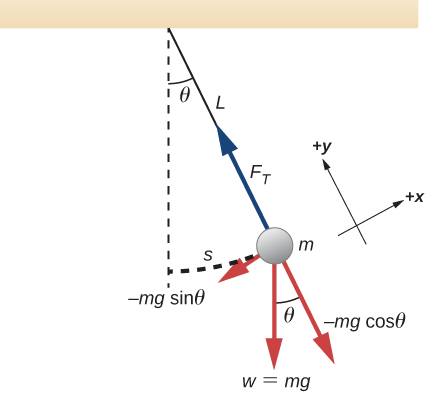
![\[\text{−}mg\text{sin}\,\theta\]](https://opentextbc.ca/universityphysicsv1openstax/wp-content/ql-cache/quicklatex.com-c8c69b484599f9c24920fbbbcc5f1565_l3.png "Rendered by QuickLaTeX.com")
toward the equilibrium position—that is, a restoring force.
Consider the torque on the pendulum. The strength providing the restoring torque is the component of the weight of the pendulum bob that acts forth the arc length. The torque is the length of the cord L times the component of the cyberspace force that is perpendicular to the radius of the arc. The minus sign indicates the torque acts in the reverse management of the angular displacement:
![\[\begin{array}{ccc}\hfill \tau & =\hfill & \text{−}L(mg\,\text{sin}\,\theta );\hfill \\ \hfill I\alpha & =\hfill & \text{−}L(mg\,\text{sin}\,\theta );\hfill \\ \hfill I\frac{{d}^{2}\theta }{d{t}^{2}}& =\hfill & \text{−}L(mg\,\text{sin}\,\theta );\hfill \\ \hfill m{L}^{2}\frac{{d}^{2}\theta }{d{t}^{2}}& =\hfill & \text{−}L(mg\,\text{sin}\,\theta );\hfill \\ \hfill \frac{{d}^{2}\theta }{d{t}^{2}}& =\hfill & -\frac{g}{L}\text{sin}\,\theta .\hfill \end{array}\]](https://opentextbc.ca/universityphysicsv1openstax/wp-content/ql-cache/quicklatex.com-0577983c5ada5b96608559770cf13786_l3.png "Rendered by QuickLaTeX.com")
The solution to this differential equation involves advanced calculus, and is beyond the scope of this text. Just note that for small angles (less than xv degrees),
![\[\text{sin}\,\theta\]](https://opentextbc.ca/universityphysicsv1openstax/wp-content/ql-cache/quicklatex.com-49dad9a7204c41e23382dc0f1190778d_l3.png "Rendered by QuickLaTeX.com")
and
![\[\theta\]](https://opentextbc.ca/universityphysicsv1openstax/wp-content/ql-cache/quicklatex.com-4c29edd802429cf80b07b851f997cf63_l3.png "Rendered by QuickLaTeX.com")
differ past less than ane%, so we tin can use the small angle approximation
![\[\text{sin}\,\theta \approx \theta .\]](https://opentextbc.ca/universityphysicsv1openstax/wp-content/ql-cache/quicklatex.com-ad5b1d13a9941a000ae6a2e68c3b35aa_l3.png "Rendered by QuickLaTeX.com")
The angle
describes the position of the pendulum. Using the small angle approximation gives an approximate solution for minor angles,
![\[\frac{{d}^{2}\theta }{d{t}^{2}}=-\frac{g}{L}\theta .\]](https://opentextbc.ca/universityphysicsv1openstax/wp-content/ql-cache/quicklatex.com-9b677641db8804bc7e491a04d44c17c7_l3.png "Rendered by QuickLaTeX.com")
Considering this equation has the same course as the equation for SHM, the solution is easy to find. The angular frequency is
![\[\omega =\sqrt{\frac{g}{L}}\]](https://opentextbc.ca/universityphysicsv1openstax/wp-content/ql-cache/quicklatex.com-6e4a2b8ede095a474eb619f9947e562e_l3.png "Rendered by QuickLaTeX.com")
and the period is
![\[T=2\pi \sqrt{\frac{L}{g}}.\]](https://opentextbc.ca/universityphysicsv1openstax/wp-content/ql-cache/quicklatex.com-80b1e4e3b7913f74e0077151f10c533f_l3.png "Rendered by QuickLaTeX.com")
The menstruum of a simple pendulum depends on its length and the acceleration due to gravity. The period is completely contained of other factors, such as mass and the maximum displacement. As with uncomplicated harmonic oscillators, the period T for a pendulum is nearly independent of amplitude, especially if
is less than most
![\[15\text{°}.\]](https://opentextbc.ca/universityphysicsv1openstax/wp-content/ql-cache/quicklatex.com-020b2c80741de433bbecb9524364a9a8_l3.png "Rendered by QuickLaTeX.com")
Even simple pendulum clocks can exist finely adjusted and remain accurate.
Notation the dependence of T on grand. If the length of a pendulum is precisely known, it can actually exist used to measure the acceleration due to gravity, as in the following instance.
Case
Measuring Dispatch due to Gravity by the Catamenia of a Pendulum
What is the acceleration due to gravity in a region where a simple pendulum having a length 75.000 cm has a period of 1.7357 s?
Strategy
We are asked to discover g given the menstruation T and the length L of a pendulum. We tin solve
![\[T=2\pi \sqrt{\frac{L}{g}}\]](https://opentextbc.ca/universityphysicsv1openstax/wp-content/ql-cache/quicklatex.com-22fd3e655b9d9b9a6bc536617fac4135_l3.png "Rendered by QuickLaTeX.com")
for g, assuming only that the angle of deflection is less than
![\[15\text{°}\]](https://opentextbc.ca/universityphysicsv1openstax/wp-content/ql-cache/quicklatex.com-686e4b605859d432637193f03a3ee2f7_l3.png "Rendered by QuickLaTeX.com")
.
Solution
- Foursquare
and solve for thousand:
![\[g=4{\pi }^{2}\frac{L}{{T}^{2}}.\]](https://opentextbc.ca/universityphysicsv1openstax/wp-content/ql-cache/quicklatex.com-5ee603190a4d9e7cd8e14a26cffc07f0_l3.png "Rendered by QuickLaTeX.com")
- Substitute known values into the new equation:
![\[g=4{\pi }^{2}\frac{0.75000\,\text{m}}{{(1.7357\,\text{s})}^{2}}.\]](https://opentextbc.ca/universityphysicsv1openstax/wp-content/ql-cache/quicklatex.com-a4d33ffdc1c56f5c32e7333fc80806e7_l3.png "Rendered by QuickLaTeX.com")
- Calculate to find yard:
![\[g=9.8281{\,\text{m/s}}^{2}.\]](https://opentextbc.ca/universityphysicsv1openstax/wp-content/ql-cache/quicklatex.com-c1597354721f35bfc2a1f9b52d4f6fca_l3.png "Rendered by QuickLaTeX.com")
Significance
This method for determining g can be very accurate, which is why length and period are given to five digits in this case. For the precision of the approximation
![\[\text{sin}\,\theta \approx \theta\]](https://opentextbc.ca/universityphysicsv1openstax/wp-content/ql-cache/quicklatex.com-9503ad6907373d6337e73f84e32711d4_l3.png "Rendered by QuickLaTeX.com")
to be better than the precision of the pendulum length and flow, the maximum displacement angle should be kept below about
![\[0.5\text{°}\]](https://opentextbc.ca/universityphysicsv1openstax/wp-content/ql-cache/quicklatex.com-18e2bcb9421c5803b8b1081bc90c84b5_l3.png "Rendered by QuickLaTeX.com")
.
Check Your Agreement
An engineer builds two simple pendulums. Both are suspended from minor wires secured to the ceiling of a room. Each pendulum hovers two cm above the floor. Pendulum 1 has a bob with a mass of 10 kg. Pendulum 2 has a bob with a mass of 100 kg. Describe how the motion of the pendulums will differ if the bobs are both displaced by
![\[12\text{°}\]](https://opentextbc.ca/universityphysicsv1openstax/wp-content/ql-cache/quicklatex.com-dbfb71cda95a068cc549d04887f9de06_l3.png "Rendered by QuickLaTeX.com")
.
[reveal-respond q="fs-id1167131444820″]Show Solution[/reveal-answer]
[subconscious-respond a="fs-id1167131444820″]
The move of the pendulums will not differ at all because the mass of the bob has no effect on the motility of a unproblematic pendulum. The pendulums are only affected by the menstruation (which is related to the pendulum's length) and by the dispatch due to gravity.
[/hidden-answer]
Physical Pendulum
Any object tin oscillate like a pendulum. Consider a coffee mug hanging on a hook in the pantry. If the mug gets knocked, it oscillates back and forth like a pendulum until the oscillations die out. We have described a simple pendulum every bit a point mass and a string. A concrete pendulum is any object whose oscillations are similar to those of the simple pendulum, merely cannot be modeled as a bespeak mass on a string, and the mass distribution must be included into the equation of motion.
As for the simple pendulum, the restoring force of the physical pendulum is the strength of gravity. With the simple pendulum, the force of gravity acts on the middle of the pendulum bob. In the instance of the physical pendulum, the force of gravity acts on the centre of mass (CM) of an object. The object oscillates about a point O. Consider an object of a generic shape every bit shown in (Effigy).
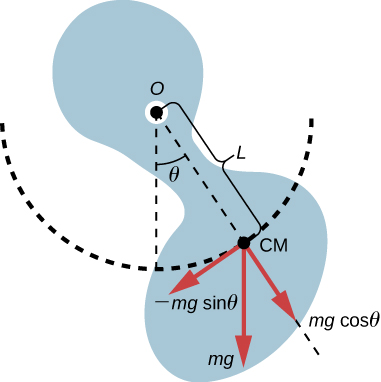
.
When a physical pendulum is hanging from a point but is costless to rotate, it rotates because of the torque applied at the CM, produced by the component of the object's weight that acts tangent to the motion of the CM. Taking the counterclockwise direction to be positive, the component of the gravitational force that acts tangent to the motility is
![\[\text{−}mg\,\text{sin}\,\theta\]](https://opentextbc.ca/universityphysicsv1openstax/wp-content/ql-cache/quicklatex.com-3959468b1ea8f60b712eb72a5eaf7969_l3.png "Rendered by QuickLaTeX.com")
. The minus sign is the effect of the restoring force interim in the reverse direction of the increasing angle. Remember that the torque is equal to
![\[\overset{\to }{\tau }=\overset{\to }{r}\,×\,\overset{\to }{F}\]](https://opentextbc.ca/universityphysicsv1openstax/wp-content/ql-cache/quicklatex.com-d2e9b9eb6b8de4146c40457ebc8bbf40_l3.png "Rendered by QuickLaTeX.com")
. The magnitude of the torque is equal to the length of the radius arm times the tangential component of the force applied,
![\[|\tau |=rF\text{sin}\,\theta\]](https://opentextbc.ca/universityphysicsv1openstax/wp-content/ql-cache/quicklatex.com-7b63ed39c312ff1b8ea99eccfb19cbfc_l3.png "Rendered by QuickLaTeX.com")
. Here, the length L of the radius arm is the altitude between the point of rotation and the CM. To analyze the motion, start with the net torque. Similar the uncomplicated pendulum, consider only small angles so that
. Recall from Fixed-Centrality Rotation on rotation that the internet torque is equal to the moment of inertia
![\[I=\int {r}^{2}dm\]](https://opentextbc.ca/universityphysicsv1openstax/wp-content/ql-cache/quicklatex.com-fdd33bda42d82668294846363d82ae79_l3.png "Rendered by QuickLaTeX.com")
times the angular dispatch
![\[\alpha ,\]](https://opentextbc.ca/universityphysicsv1openstax/wp-content/ql-cache/quicklatex.com-b2528c609e0d3f57379f95771c33b2ea_l3.png "Rendered by QuickLaTeX.com")
where
![\[\alpha =\frac{{d}^{2}\theta }{d{t}^{2}}\]](https://opentextbc.ca/universityphysicsv1openstax/wp-content/ql-cache/quicklatex.com-47ef5a4d4bbb8eb367c7465fbfcac3cd_l3.png "Rendered by QuickLaTeX.com")
:
![\[I\alpha ={\tau }_{\text{net}}=L(\text{−}mg)\text{sin}\,\theta .\]](https://opentextbc.ca/universityphysicsv1openstax/wp-content/ql-cache/quicklatex.com-85fa5b84532ed2f01d080914240de1fa_l3.png "Rendered by QuickLaTeX.com")
Using the small bending approximation and rearranging:
![\[\begin{array}{ccc}\hfill I\alpha & =\hfill & \text{−}L(mg)\theta ;\hfill \\ \hfill I\frac{{d}^{2}\theta }{d{t}^{2}}& =\hfill & \text{−}L(mg)\theta ;\hfill \\ \hfill \frac{{d}^{2}\theta }{d{t}^{2}}& =\hfill & \text{−}(\frac{mgL}{I})\theta .\hfill \end{array}\]](https://opentextbc.ca/universityphysicsv1openstax/wp-content/ql-cache/quicklatex.com-970e98b5e62fb66a4a52d02611acc4e4_l3.png "Rendered by QuickLaTeX.com")
Over again, the equation says that the second time derivative of the position (in this example, the angle) equals minus a constant
![\[(-\frac{mgL}{I})\]](https://opentextbc.ca/universityphysicsv1openstax/wp-content/ql-cache/quicklatex.com-068e636c4dfb26081f33b6ea7017d198_l3.png "Rendered by QuickLaTeX.com")
times the position. The solution is
![\[\theta (t)=\text{Θ}\text{cos}(\omega t+\varphi ),\]](https://opentextbc.ca/universityphysicsv1openstax/wp-content/ql-cache/quicklatex.com-51ed721aab9593ecb0dbedc1124a12bc_l3.png "Rendered by QuickLaTeX.com")
where
![\[\text{Θ}\]](https://opentextbc.ca/universityphysicsv1openstax/wp-content/ql-cache/quicklatex.com-b1b111b38bc0eae6390be7bf6ef2faf5_l3.png "Rendered by QuickLaTeX.com")
is the maximum angular displacement. The athwart frequency is
![\[\omega =\sqrt{\frac{mgL}{I}}.\]](https://opentextbc.ca/universityphysicsv1openstax/wp-content/ql-cache/quicklatex.com-116456f0f857bc7faec0eef61bb7864e_l3.png "Rendered by QuickLaTeX.com")
The period is therefore
![\[T=2\pi \sqrt{\frac{I}{mgL}}.\]](https://opentextbc.ca/universityphysicsv1openstax/wp-content/ql-cache/quicklatex.com-90c5c702399dc7ad816be54bcd0d6e9b_l3.png "Rendered by QuickLaTeX.com")
Note that for a simple pendulum, the moment of inertia is
![\[I=\int {r}^{2}dm=m{L}^{2}\]](https://opentextbc.ca/universityphysicsv1openstax/wp-content/ql-cache/quicklatex.com-6dc2d8515dddadb38a448f3a4823d8b2_l3.png "Rendered by QuickLaTeX.com")
and the flow reduces to
.
Example
Reducing the Swaying of a Skyscraper
In extreme conditions, skyscrapers can sway up to 2 meters with a frequency of up to 20.00 Hz due to high winds or seismic action. Several companies have adult physical pendulums that are placed on the top of the skyscrapers. As the skyscraper sways to the correct, the pendulum swings to the left, reducing the sway. Assuming the oscillations have a frequency of 0.50 Hz, pattern a pendulum that consists of a long axle, of constant density, with a mass of 100 metric tons and a pivot point at ane cease of the beam. What should be the length of the beam?
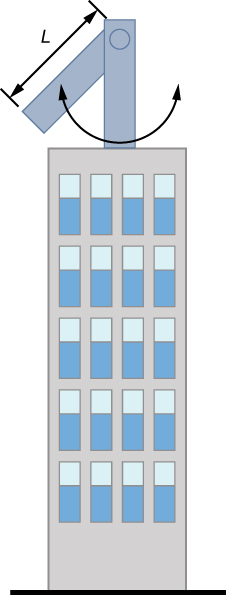
Strategy
Nosotros are asked to notice the length of the physical pendulum with a known mass. Nosotros kickoff need to find the moment of inertia of the axle. We can then employ the equation for the period of a concrete pendulum to find the length.
Solution
- Observe the moment of inertia for the CM:
- Use the parallel axis theorem to find the moment of inertia about the signal of rotation:
![\[I={I}_{\text{CM}}+{\frac{L}{4}}^{2}M=\frac{1}{12}M{L}^{2}+\frac{1}{4}M{L}^{2}=\frac{1}{3}M{L}^{2}.\]](https://opentextbc.ca/universityphysicsv1openstax/wp-content/ql-cache/quicklatex.com-c8be3f226b93645ffe08a9c784626798_l3.png "Rendered by QuickLaTeX.com")
- The period of a concrete pendulum has a period of
![\[T=2\pi \sqrt{\frac{I}{mgL}}\]](https://opentextbc.ca/universityphysicsv1openstax/wp-content/ql-cache/quicklatex.com-a8f353e7e1fdcb80506d5d6470a815dc_l3.png "Rendered by QuickLaTeX.com")
. Use the moment of inertia to solve for the length L:
![\[\begin{array}{ccc}\hfill T& =\hfill & 2\pi \sqrt{\frac{I}{MgL}}=2\pi \sqrt{\frac{\frac{1}{3}M{L}^{2}}{MgL}}=2\pi \sqrt{\frac{L}{3g}};\hfill \\ \hfill L& =\hfill & 3g{(\frac{T}{2\pi })}^{2}=3(9.8\frac{\text{m}}{{\text{s}}^{2}}){(\frac{2\,\text{s}}{2\pi })}^{2}=2.98\,\text{m}\text{.}\hfill \end{array}\]](https://opentextbc.ca/universityphysicsv1openstax/wp-content/ql-cache/quicklatex.com-fbee2ee1ef5ed7b125eaa35e511a4769_l3.png "Rendered by QuickLaTeX.com")
Significance
There are many ways to reduce the oscillations, including modifying the shape of the skyscrapers, using multiple physical pendulums, and using tuned-mass dampers.
Torsional Pendulum
A torsional pendulum consists of a rigid trunk suspended by a low-cal wire or spring ((Figure)). When the body is twisted some small maximum bending
![\[(\text{Θ})\]](https://opentextbc.ca/universityphysicsv1openstax/wp-content/ql-cache/quicklatex.com-ed6bf205bafa1cc8220b8fdaf0ceabbd_l3.png "Rendered by QuickLaTeX.com")
and released from rest, the trunk oscillates betwixt
![\[(\theta =+\text{Θ})\]](https://opentextbc.ca/universityphysicsv1openstax/wp-content/ql-cache/quicklatex.com-61675033b6fdf1e80463ddf181138d36_l3.png "Rendered by QuickLaTeX.com")
and
![\[(\theta =\text{−}\,\text{Θ})\]](https://opentextbc.ca/universityphysicsv1openstax/wp-content/ql-cache/quicklatex.com-37033f15fa4852797bd0aef24af7959a_l3.png "Rendered by QuickLaTeX.com")
. The restoring torque is supplied past the shearing of the string or wire.
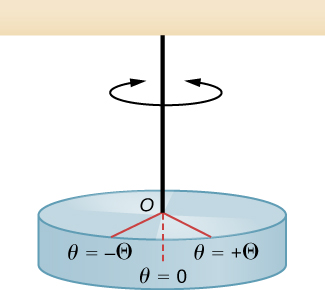
![\[\theta =+\text{Θ}\]](https://opentextbc.ca/universityphysicsv1openstax/wp-content/ql-cache/quicklatex.com-91e75f20e87abc0aa73aaff179f0b2f3_l3.png "Rendered by QuickLaTeX.com")
and
![\[\theta =\text{−}\text{Θ}\]](https://opentextbc.ca/universityphysicsv1openstax/wp-content/ql-cache/quicklatex.com-12c0f19719d49e2de146a1c246be7c67_l3.png "Rendered by QuickLaTeX.com")
.
The restoring torque can exist modeled equally being proportional to the angle:
![\[\tau =\text{−}\kappa \theta .\]](https://opentextbc.ca/universityphysicsv1openstax/wp-content/ql-cache/quicklatex.com-7f30a717ae04a0bea4187f4548cc8b8c_l3.png "Rendered by QuickLaTeX.com")
The variable kappa
![\[(\kappa )\]](https://opentextbc.ca/universityphysicsv1openstax/wp-content/ql-cache/quicklatex.com-7d1029a39204d5c8833b168457c293cd_l3.png "Rendered by QuickLaTeX.com")
is known as the torsion abiding of the wire or string. The minus sign shows that the restoring torque acts in the opposite direction to increasing angular displacement. The net torque is equal to the moment of inertia times the angular acceleration:
*** QuickLaTeX cannot compile formula: \[\begin{array}{}\\ I\frac{{d}^{2}\theta }{d{t}^{ii}}=\text{−}\kappa \theta ;\hfill \\ \frac{{d}^{2}\theta }{d{t}^{2}}=-\frac{\kappa }{I}\theta .\hfill \end{assortment}\] *** Error message: Missing # inserted in alignment preamble. leading text: \[\begin{array}{} Missing $ inserted. leading text: ...array}{}\\ I\frac{{d}^{2}\theta }{d{t}^{2}} Missing $ inserted. leading text: ...array}{}\\ I\frac{{d}^{ii}\theta }{d{t}^{two}} Missing $ inserted. leading text: ...array}{}\\ I\frac{{d}^{2}\theta }{d{t}^{2}} Extra }, or forgotten $. leading text: ...assortment}{}\\ I\frac{{d}^{two}\theta }{d{t}^{two}} Package inputenc Error: Unicode character − (U+2212) leading text: ...I\frac{{d}^{ii}\theta }{d{t}^{2}}=\text{−} Missing } inserted. leading text: ...}}=\text{−}\kappa \theta ;\hfill \\ \frac Actress }, or forgotten $. leading text: ...}}=\text{−}\kappa \theta ;\hfill \\ \frac Missing } inserted. leading text: ...}}=\text{−}\kappa \theta ;\hfill \\ \frac This equation says that the second time derivative of the position (in this example, the bending) equals a negative constant times the position. This looks very similar to the equation of motion for the SHM
![\[\frac{{d}^{2}x}{d{t}^{2}}=-\frac{k}{m}x\]](https://opentextbc.ca/universityphysicsv1openstax/wp-content/ql-cache/quicklatex.com-00f730ec2c6979b185edf21de690716a_l3.png "Rendered by QuickLaTeX.com")
, where the period was found to exist
![\[T=2\pi \sqrt{\frac{m}{k}}\]](https://opentextbc.ca/universityphysicsv1openstax/wp-content/ql-cache/quicklatex.com-a343f0b7b04a17e4dd6a54d19e4df777_l3.png "Rendered by QuickLaTeX.com")
. Therefore, the period of the torsional pendulum can be found using
![\[T=2\pi \sqrt{\frac{I}{\kappa }}.\]](https://opentextbc.ca/universityphysicsv1openstax/wp-content/ql-cache/quicklatex.com-98e2dd17ebea1e2995a94c4be189fc94_l3.png "Rendered by QuickLaTeX.com")
The units for the torsion constant are
![\[[\kappa ]=\text{N-m}=(\text{kg}\frac{\text{m}}{{\text{s}}^{2}})\text{m}=\text{kg}\,\frac{{\text{m}}^{2}}{{\text{s}}^{2}}\]](https://opentextbc.ca/universityphysicsv1openstax/wp-content/ql-cache/quicklatex.com-e6b4e52b68648702a9e862cb60e169cb_l3.png "Rendered by QuickLaTeX.com")
and the units for the moment of inertial are
![\[[I]={\text{kg-m}}^{2},\]](https://opentextbc.ca/universityphysicsv1openstax/wp-content/ql-cache/quicklatex.com-00dc2372c40baca83ba29742bc241caf_l3.png "Rendered by QuickLaTeX.com")
which show that the unit for the period is the second.
Instance
Measuring the Torsion Constant of a Cord
A rod has a length of
![\[l=0.30\,\text{m}\]](https://opentextbc.ca/universityphysicsv1openstax/wp-content/ql-cache/quicklatex.com-7fdf864e751fc124ba2289bfebb4040b_l3.png "Rendered by QuickLaTeX.com")
and a mass of four.00 kg. A string is attached to the CM of the rod and the system is hung from the ceiling ((Figure)). The rod is displaced ten degrees from the equilibrium position and released from residuum. The rod oscillates with a menses of 0.5 s. What is the torsion constant
![\[\kappa\]](https://opentextbc.ca/universityphysicsv1openstax/wp-content/ql-cache/quicklatex.com-ccf7fd32d60ddc446fd269922614300a_l3.png "Rendered by QuickLaTeX.com")
?
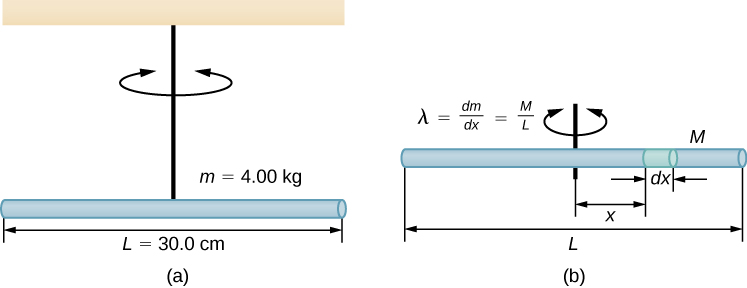
Strategy
We are asked to observe the torsion constant of the cord. Nosotros first need to observe the moment of inertia.
Solution
- Detect the moment of inertia for the CM:
![\[{I}_{\text{CM}}=\int {x}^{2}dm={\int }_{\text{−}L\text{/}2}^{+L\text{/}2}{x}^{2}\lambda dx=\lambda {[\frac{{x}^{3}}{3}]}_{\text{−}L\text{/}2}^{+L\text{/}2}=\lambda \frac{2{L}^{3}}{24}=(\frac{M}{L})\frac{2{L}^{3}}{24}=\frac{1}{12}M{L}^{2}.\]](https://opentextbc.ca/universityphysicsv1openstax/wp-content/ql-cache/quicklatex.com-f94b595315b1c9fc303df3b651b6ea71_l3.png "Rendered by QuickLaTeX.com")
- Summate the torsion constant using the equation for the catamenia:
![\[\begin{array}{ccc}\hfill T& =\hfill & 2\pi \sqrt{\frac{I}{\kappa }};\hfill \\ \hfill \kappa & =\hfill & I{(\frac{2\pi }{T})}^{2}=(\frac{1}{12}M{L}^{2}){(\frac{2\pi }{T})}^{2};\hfill \\ & =\hfill & (\frac{1}{12}(4.00\,\text{kg}){(0.30\,\text{m})}^{2}){(\frac{2\pi }{0.50\,\text{s}})}^{2}=4.73\,\text{N}·\text{m}\text{.}\hfill \end{array}\]](https://opentextbc.ca/universityphysicsv1openstax/wp-content/ql-cache/quicklatex.com-b0928dd8430ef6d7b28a47d92ad12d0e_l3.png "Rendered by QuickLaTeX.com")
Significance
Like the strength constant of the system of a cake and a spring, the larger the torsion constant, the shorter the menstruum.
Summary
- A mass thou suspended by a wire of length L and negligible mass is a simple pendulum and undergoes SHM for amplitudes less than about
. The period of a simple pendulum is
, where L is the length of the string and g is the acceleration due to gravity.
- The flow of a physical pendulum
can be found if the moment of inertia is known. The length between the signal of rotation and the center of mass is 50.
- The menstruation of a torsional pendulum
![\[T=2\pi \sqrt{\frac{I}{\kappa }}\]](https://opentextbc.ca/universityphysicsv1openstax/wp-content/ql-cache/quicklatex.com-94bea91daf45f2ff0d575bf8ea18dfcd_l3.png "Rendered by QuickLaTeX.com")
tin can be found if the moment of inertia and torsion constant are known.
Conceptual Questions
Pendulum clocks are made to run at the right rate by adjusting the pendulum's length. Suppose yous move from one city to another where the dispatch due to gravity is slightly greater, taking your pendulum clock with you, will yous have to lengthen or shorten the pendulum to continue the correct time, other factors remaining constant? Explain your respond.
A pendulum clock works by measuring the period of a pendulum. In the springtime the clock runs with perfect time, but in the summer and winter the length of the pendulum changes. When most materials are heated, they aggrandize. Does the clock run too fast or too slow in the summer? What virtually the winter?
[reveal-answer q="fs-id1167134926082″]Show Solution[/reveal-respond]
[subconscious-respond a="fs-id1167134926082″]
The period of the pendulum is
![\[T=2\pi \sqrt{L\text{/}g}.\]](https://opentextbc.ca/universityphysicsv1openstax/wp-content/ql-cache/quicklatex.com-0c0905650883ef785b6becacc1709ee1_l3.png "Rendered by QuickLaTeX.com")
In summer, the length increases, and the period increases. If the flow should exist one second, but menstruum is longer than one second in the summer, it will oscillate fewer than sixty times a minute and clock will run slow. In the wintertime information technology will run fast.
[/subconscious-answer]
With the use of a stage shift, the position of an object may exist modeled as a cosine or sine function. If given the option, which function would you lot choose? Assuming that the phase shift is zero, what are the initial weather condition of office; that is, the initial position, velocity, and acceleration, when using a sine function? How virtually when a cosine function is used?
Problems
What is the length of a pendulum that has a period of 0.500 s?
Some people think a pendulum with a menstruation of 1.00 due south tin exist driven with "mental energy" or psycho kinetically, because its period is the same as an average heartbeat. True or not, what is the length of such a pendulum?
[reveal-respond q="fs-id1167131468450″]Evidence Solution[/reveal-answer]
[hidden-answer a="fs-id1167131468450″]
24.8 cm
[/subconscious-reply]
What is the flow of a ane.00-g-long pendulum?
How long does it take a child on a swing to complete i swing if her middle of gravity is iv.00 m below the pivot?
[reveal-answer q="fs-id1167131602999″]Prove Solution[/reveal-answer]
[subconscious-reply a="fs-id1167131602999″]
4.01 due south
[/hidden-answer]
The pendulum on a cuckoo clock is five.00-cm long. What is its frequency?
Two parakeets sit on a swing with their combined CMs 10.0 cm below the pivot. At what frequency practice they swing?
[reveal-reply q="fs-id1167134910173″]Show Solution[/reveal-answer]
[hidden-respond a="fs-id1167134910173″]
i.58 s
[/hidden-answer]
(a) A pendulum that has a menstruum of 3.00000 south and that is located where the acceleration due to gravity is
![\[9.79\,{\text{m/s}}^{2}\]](https://opentextbc.ca/universityphysicsv1openstax/wp-content/ql-cache/quicklatex.com-2b489c4ea5b50b980257e26362905c07_l3.png "Rendered by QuickLaTeX.com")
is moved to a location where the dispatch due to gravity is
![\[9.82\,{\text{m/s}}^{2}\]](https://opentextbc.ca/universityphysicsv1openstax/wp-content/ql-cache/quicklatex.com-a1502ec33cac4ef536dadc101347bf27_l3.png "Rendered by QuickLaTeX.com")
. What is its new period? (b) Explicate why so many digits are needed in the value for the menstruation, based on the relation between the period and the dispatch due to gravity.
A pendulum with a catamenia of 2.00000 s in one location (
![\[g=9.80{\text{m/s}}^{2}\]](https://opentextbc.ca/universityphysicsv1openstax/wp-content/ql-cache/quicklatex.com-7bde8e95ec732e93e673f56af6df0295_l3.png "Rendered by QuickLaTeX.com")
) is moved to a new location where the period is now 1.99796 s. What is the acceleration due to gravity at its new location?
[reveal-answer q="fs-id1167131471258″]Evidence Solution[/reveal-respond]
[hidden-answer a="fs-id1167131471258″]
![\[9.82002\,{\text{m/s}}^{2}\]](https://opentextbc.ca/universityphysicsv1openstax/wp-content/ql-cache/quicklatex.com-5e88ffcea8ad450e8bb23a9006e1dcce_l3.png "Rendered by QuickLaTeX.com")
[/subconscious-reply]
(a) What is the effect on the period of a pendulum if you double its length? (b) What is the result on the period of a pendulum if you decrease its length by 5.00%?
Glossary
- concrete pendulum
- any extended object that swings like a pendulum
- simple pendulum
- point mass, called a pendulum bob, attached to a about massless string
- torsional pendulum
- any suspended object that oscillates by twisting its suspension
Source: https://opentextbc.ca/universityphysicsv1openstax/chapter/15-4-pendulums/
0 Response to "Review the Graph of Amplitude Vs Time for a Pendulum Below"
Post a Comment